Digital air traffic control
Solution
Digital air traffic control for different users
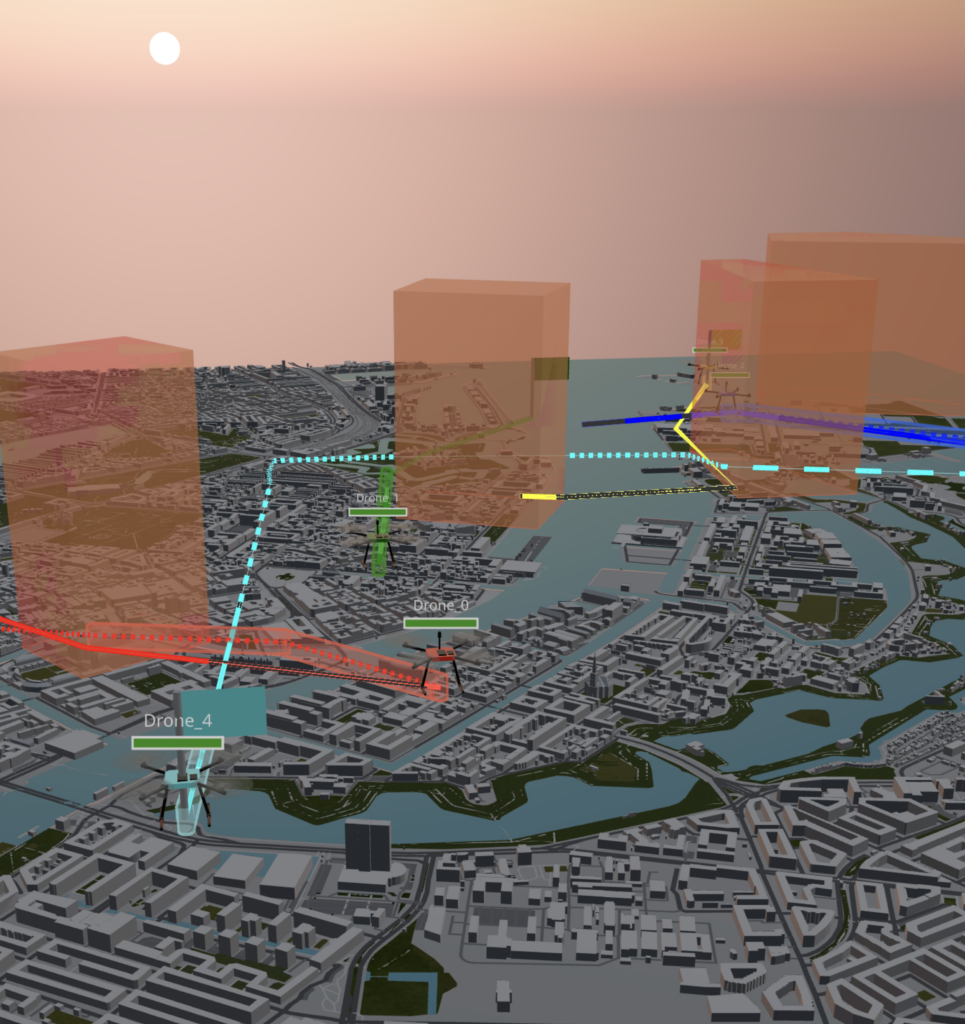
Skypuzzler’s core innovation, integrated Digital Air Traffic Control (iDATC), is an advanced Tactical Conflict Resolution Service (CRS) designed to overcome the “one-pilot-one-drone” bottleneck.
Ensuring flight safety
iDATC is a flexible, standalone solution that seamlessly integrates with existing Uncrewed Traffic Management (UTM) and Flight Management Systems (FMS). Unlike traditional platforms that depend on closed or proprietary systems, iDATC uses advanced data aggregation to deliver real-time, actionable insights.
By combining inputs from flight plans, tracking systems, Ground Control Stations (GCS), geospatial (GEO) data, and weather sources, iDATC turns complex information into clear intelligence. The result? Smarter conflict resolution, safer airspace management, and enhanced flight safety for crewed and uncrewed aircraft.
Multi-Drone operations support
One operator can safely manage multiple drones simultaneously with iDATC supervision.
Swarm Integration
Swarms are organised around a lead drone that communicates directly with iDATC, ensuring separation to and from other airspace users, mirroring principles of formation flight in conventional aviation.
Real-Time Conflict Resolution
Unlike reactive systems (AI trained on historical data), iDATC uses mathematical models to determine and prevent conflicts before they occur. This enables large-scale drone operations and significantly enhances operational efficiency, safety, and airspace integration. It offers transparent, explainable, and deterministic outcomes.
Holistic Situational Awareness
Utilise real-time data from existing systems e.g. tracking of airspace users (drones, crewed aviation), radars, weather, and regulatory constraints for a complete operational picture.
Navigation System Agnostic
The system does not depend on a single navigation infrastructure, ensuring resilience under degraded or GPS-denied conditions.
Rapid Deployment and Scalability
Deployable on-premises or via secure cloud infrastructure; rapidly scalable and easily integrated into existing defence or civil aviation frameworks. No need for extra hardware on the drones, as it integrates with the flight management system.
Why choose iDATC?
Key Capabilities
A holistic view
At its core, iDATC empowers both strategic and tactical deconfliction, enabling dynamic airspace configuration for safe and efficient drone operations Beyond Visual Line of Sight (BVLOS). By creating a holistic, real-time view of air traffic, iDATC supports predictive conflict resolution and adaptive mission execution.
This capability is essential in complex environments such as offshore installations, harbor zones, and urban airspace — where traditional systems often restrict the number of simultaneous drone operations. iDATC removes these barriers, unlocking safer, smarter, and more scalable aerial missions.
who we serve
Users
Drone Operators
Discover how Skypuzzler helps drone operators scale their missions safely and efficiently.
UTM Providers
Learn how Skypuzzler integrates seamlessly with UTM providers to enhance airspace connectivity.
ANSP
See how Skypuzzler supports ANSPs in managing digital air traffic with precision and reliability.
National security
Explore how Skypuzzler empowers national security by scaling drone operations to strengthen defence capabilities.
Authorities
Find out how Skypuzzler enables smart regulation and oversight for emerging airspace operations.
Applying principles from traditional aviation to drone conflict management is vital for scalability and maintaining a high flight safety standard to avoid risk of collisions.
It is essential to clarify that Detect-and-Avoid (DAA) is the last safety barrier and collision avoidance function, distinct from tactical deconfliction. Relying solely on DAA will be the same as removing air traffic controllers in traditional aviation.
Tactical deconfliction requires an automated solution based on advanced algorithms working in real-time with a holistic traffic view, especially in high-density traffic situations and complex traffic patterns.
The Global Air Traffic Management Operational Concept (ICAO Doc 9854) states that conflict management consists of three layers:
- Strategic deconfliction,
- Tactical deconfliction,
- Collision avoidance (DAA)